Project summary
This US Shopify store saw a substantial drop in search traffic in January 2024. The owner partnered with our team in August 2024 to revive the store’s SEO, on one condition we share: only sustainable, Google-approved practices.
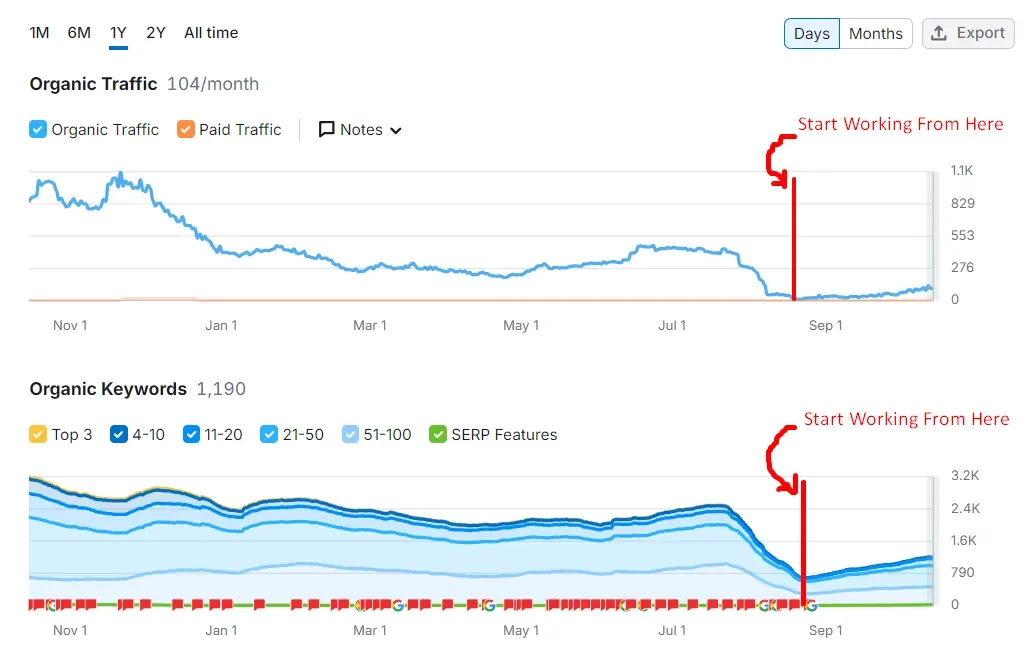
The charts come from Semrush. In the traffic chart, the “Start Working From Here” line marks where our work began. We keep the shop’s name and URL confidential.
The problem: a deep, ongoing decline
By August the damage was significant. In Semrush, organic traffic had fallen from around 1.1K to almost nothing, and organic keywords from around 3.2K to roughly 600.
A drop like this tempts many store owners into shortcuts. We do not use them. Quick fixes tend to trigger the next fall; lasting recovery comes from work that stays inside Google Search Essentials.
Our strategy
Recovery has two stages. First, stop the fall by finding what changed and fixing it. Then win back lost ground with pages that answer queries plainly, a tidy site and genuine authority. It is slower than a trick, but it holds.
Why we chose a slow, safe recovery
When rankings fall sharply, the pressure to act fast is huge. Many shortcuts promise a quick bounce: bulk links, copied content, tricks aimed at search engines rather than shoppers. They break Google’s spam policies, and even when they seem to work for a while, they can trigger the next drop. The owner wanted the store back for good, and so did we, so we only used Google-approved practices.
That choice decided the order of work. First, understand the drop with a full audit. Second, find the keywords the store had lost and the pages that used to win them. Third, improve those pages and rebuild authority with genuine backlinks.
Step by step: what our team did
-
Complete Shopify audit to pin down what had shifted and what was dragging the store down.
- Lost-keyword research. We listed the queries the shop ought to own and compared them with the rankings it had dropped.
- On-page SEO improvements on the pages targeting those keywords.
- Backlinks to rebuild the store’s authority.
- Shopify-specific SEO handled throughout the project.
What each step involved, and why it mattered
The audit
A ranking drop always has causes, and they are rarely obvious from the traffic chart alone. The audit looked at the whole Shopify store for technical, on-page and content problems, so the fixes targeted real issues rather than guesses.
Lost-keyword research
Comparing the keywords the store should rank for with the ones it still held showed exactly where visibility had gone. This turned a vague “traffic is down” into a list of pages and searches to win back.
On-page improvements
The pages targeting the lost keywords were improved, so each clearly matched what shoppers search for and gave Google a strong reason to show it again.
Backlinks
A store recovering from a drop needs to rebuild trust. Genuine backlinks from relevant sites help with that, and they keep working long after a shortcut would have stopped.
Shopify-specific SEO
Shopify has its own patterns, such as how it builds collection and product URLs. We handled these throughout, so platform quirks didn’t undo the rest of the work.
Results
- Increased clicks and impressions from search, and better keyword rankings.
Semrush shows organic traffic bottoming out just as our work began and then climbing again, reaching 104 visits a month when the screenshot was taken.
Ranking keywords rebound in that chart too, back up to 1,190.
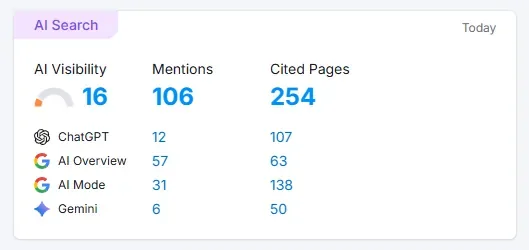
In Semrush’s AI Search report the store scores 16 for AI Visibility, with 106 mentions and 254 cited pages; by platform: ChatGPT 12/107, AI Overview 57/63, AI Mode 31/138, Gemini 6/50 (mentions/cited pages).
What we would do next
Organic keywords have recovered to 1,190 in Semrush, but traffic was still far below the level the store had before the drop. The next step would be to keep improving the pages behind the lost keywords that have not come back yet, and to keep building authority steadily. The AI search report also shows the store is already being mentioned and cited, so keeping pages clear and well structured supports that channel too.
What this project taught us
Bringing a damaged store back takes longer than growing one that was never hit. Step one is halting the slide, and the graph shows just that: the drop stops when our work starts and the line heads up again. Steady on-page work and backlinks then rebuild what was lost, one step at a time.
Questions store owners often ask
How long does a ranking recovery take?
It depends on the cause and the damage. Here, the first visible change was the decline stopping where our work began, followed by a gradual climb.
Why not use quick fixes?
Shortcuts that break Google’s spam policies can cause a new drop. A recovery built on approved practices is slower but holds.
Has your store lost rankings?
Do not panic and do not chase shortcuts. Diagnose the cause before touching anything, then repair it the right way. Our Shopify SEO services include recovery audits, and our eCommerce SEO agency page explains how we work.
Evidence from the project
Screenshots from the client's own tools. Click to enlarge.