Project summary
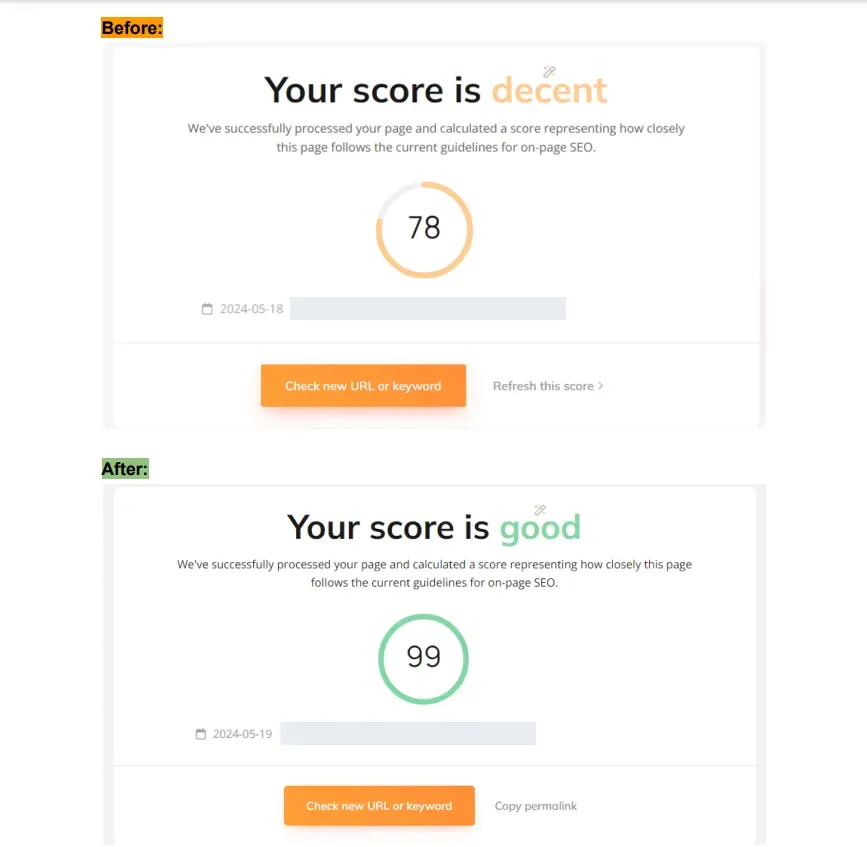
After our team completed a full on-page and technical checklist on a WordPress page, its score in an on-page SEO checker climbed from 78 to 99.
Both results come from the same checker, run on 18 May 2024 and 19 May 2024. The screenshot masks the URL and the target keyword.
What an on-page score tells you
Such tools compare a page with its target keyword and rate how well it follows on-page best practice across title, description, headings, keyword placement, images and links. The tool rates 78 as “decent” and 99 as “good”. The number is not a ranking, yet it works as a handy checklist, since each flagged item makes the page slightly less clear.
The situation in more detail
The page already scored 78, which the checker rates as “decent”. So this was not a rescue job. It was about closing the gap between “decent” and “good” with careful, complete on-page and technical work, run against the same checker before and after, on 18 and 19 May 2024.
Our strategy
Confirm the right keyword first, check what already ranks, then fix every flagged point for the reader first. Behind that, make sure the page can actually be reached and understood, because a perfect score is wasted on a blocked, slow or duplicated page.
Why we chose this approach
An on-page score is a checklist, not a ranking. We used it that way. We confirmed the target keyword first, because optimizing for the wrong keyword would raise the score without helping the page. Then we fixed each flagged point for the reader first. Behind that, technical checks made sure the page could actually be crawled, indexed and loaded quickly.
Step by step: what our team did
- Website audit, keyword confirmation and competitor check of pages already ranking.
- On-page fixes: title and meta description, heading tags, keyword use, featured image, clean permalink, internal and external links, and image SEO.
- Technical checks: robots.txt and sitemap.xml, mobile friendliness, 404 fixes, featured snippet opportunities, page speed, mobile and desktop indexing, canonical URLs and schema markup.
What each step involved, and why it mattered
Audit, keyword and competitors
The audit showed the page’s starting point, the keyword check confirmed what it should target, and the competitor check showed what the pages already ranking were doing.
On-page fixes
Title and meta description, heading tags, keyword use, featured image, permalink, internal and external links and image SEO were each brought in line with the checker’s guidelines, while keeping the page natural to read.
Technical checks
robots.txt and sitemap.xml, mobile friendliness, 404 fixes, page speed, mobile and desktop indexing, canonical URLs and schema markup were checked. We also looked for featured snippet opportunities.
Results
- On-page SEO score 78 → 99.
- 18 May 2024: 78, rated “decent”. 19 May 2024: 99, rated “good”.
What we would do next
With the page scoring 99, the next step is to watch how it ranks, then apply the same process to the site’s other important pages.
What this project taught us
Most of the gap between “decent” and “good” comes from small, careful fixes. No single fix is difficult; completing every one carefully in one day is what lifted the page. Improve the page for people first and the score tends to rise with it.
Questions website owners often ask
Does a score of 99 mean the page will rank first?
No. On-page scores measure how closely a page follows guidelines for its keyword. Rankings also depend on competition, authority and how useful the page is.
Is it worth chasing a perfect score?
Only if each fix makes the page clearer for readers. We never add keywords just to raise a score, because keyword stuffing goes against Google’s spam policies.
Want your pages checked?
See our WordPress SEO services or SEO services.
Evidence from the project
Screenshots from the client's own tools. Click to enlarge.