Project summary
This WordPress website was brand new and had no organic traffic at all. Our team handled its SEO from the start, and within 90 days of its first rankings appearing, the site was receiving its first organic visitors from Google.
We want to be clear about scale: these are small, early-stage numbers. What follows is a launch story about first rankings and first clicks, not a sales figure. Data comes from Google Search Console and Semrush, and the client stays private.
The problem: a site Google does not know yet
A new website has no history, no rankings, no backlinks and no trust. Search engines have to discover each page, crawl it, make sense of it and judge it worth ranking. Get the fundamentals wrong at launch and a fresh domain can stay invisible for months.
How to read these numbers
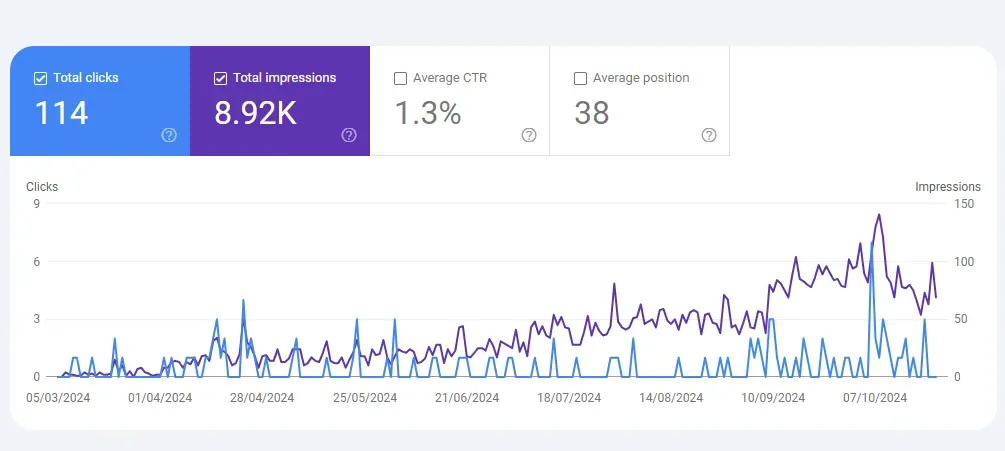
On a new site, the first chart worth watching is impressions, not clicks. Impressions count how often Google showed a page in results, even when nobody clicked. When impressions rise steadily, Google is testing the site for more searches. Clicks follow later, once pages move closer to the top. So the rise from almost nothing to over 100 daily impressions was the metric that counted most here, more than total clicks.
Our strategy
Build the SEO base properly from the start: an easy-to-crawl site, a clear job for every page, realistic keyword targets for a new domain, and the first links to earn trust.
Why we chose this approach for a new site
A new domain cannot win the most competitive searches straight away, however good its pages are. So instead of chasing big keywords, we targeted searches a new site could realistically rank for, and made sure the technical base gave Google no reason to hold back. Early rankings on smaller searches build the trust a site needs before it can compete for larger ones.
We also did everything at once rather than in separate phases. A new site has no old problems to clean up, so on-page, technical and early link work could all start together.
Step by step: what our team did
- Website audit to see what was in place and what was missing.
- Keyword research focused on searches a new site could realistically win, mapped to its pages.
- Competitor analysis of the sites already ranking.
- On-page SEO: titles, meta descriptions and heading tags, keyword use, featured images, clean permalinks, internal and external links, and image SEO.
- Technical SEO: robots.txt and sitemap.xml set up and checked, mobile friendliness, 404 fixes, featured snippet opportunities, page load time, mobile and desktop indexing checks, canonical URLs and schema markup.
Link building to give the young domain its first authority signals.
Why the technical checks matter on a new site
A wrong line in robots.txt can block a whole site. The sitemap hands Google a clean list of pages. Canonicals stop duplicate versions from competing. Structured data tells Google what each page covers, and repairing 404s closes off broken paths. Google mainly uses the mobile version of a site, so mobile indexing and speed were checked as well.
What each step involved, and why it mattered
Audit, keyword research and competitors
The audit showed what was already set up and what was missing. Keyword research and competitor analysis then showed which searches were realistic for a new domain and what the sites ranking for them were doing.
On-page SEO
Each page got a focused title and meta description, a clear heading structure and sensible keyword use. Featured images, clean permalinks, internal and external links and image SEO completed the basics. These give Google a clear picture of what every page is about.
Technical SEO
Our checklist covered robots.txt and sitemap.xml setup, a mobile-friendliness check, 404 repairs, faster load times, mobile and desktop indexing checks, canonical tags and schema markup. We also looked for featured snippet opportunities, where a clearly structured answer can earn a prominent spot in results.
First backlinks
A new domain has no authority. The first backlinks give Google outside signals that the site is real and worth showing.
Results
-
Search Console, 5 Mar 2024 – around Oct 2024: 114 clicks from 8.92K impressions, CTR 1.3%, average position 38. Impressions per day climb consistently, from almost none to over 100.
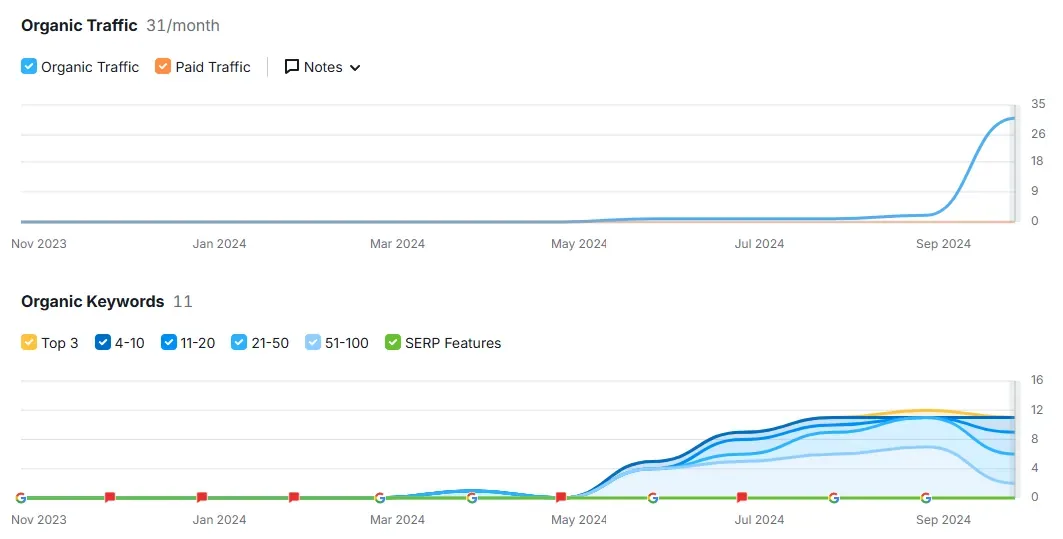
Semrush, Nov 2023 – Sep 2024: organic traffic is flat at zero until roughly May 2024, then grows to an estimated 31 monthly visits by September. Organic keywords go from 0 to 11, with Top 3 and positions 4–10 rankings appearing from May 2024.
What we would do next
With an average position of 38 in Search Console, most pages were still well below page one. The next step would be to build on the keywords that had already reached the top positions, add pages for related searches, and keep earning authority so the site could compete for bigger keywords over time.
What this project taught us
Large traffic numbers are not the opening target for a new domain. It is earning enough trust for Google to show the site at all. Rising impressions confirmed the approach was paying off, and the site’s first Top 3 and page-one positions came after.
Questions owners of new websites often ask
How long does SEO take for a new website?
There is no fixed timeline. On this site, Semrush showed no organic traffic until about May 2024, and the first organic visitors and Top 3 rankings appeared after that. Until Google trusts a site, the early months are mostly about foundations.
Should a new site target big keywords?
Not at first. A new domain usually wins specific, lower-competition searches first, and those early rankings build the trust it needs for bigger ones.
Launching a new website?
Nail the technical and on-page fundamentals at launch, go after winnable queries, and give it time. See our WordPress SEO services or general SEO services.
Evidence from the project
Screenshots from the client's own tools. Click to enlarge.