Project summary
This website operates in the health care space. The goal was straightforward: help more people find it through Google. During the project, the site’s traffic increased by 445%.
Data comes from the site’s Google Search Console and from Semrush. The two reports cover different periods, so we show each one with its own dates. The website address is hidden.
A note on YMYL
Google treats health as a YMYL (“Your Money or Your Life”) subject and holds it to an unusually strict trust bar. Our work here was search optimization only. No medical guidance was written or edited by our team, and nothing here claims any health result.
The problem: pages Google was not indexing
The project goals pointed to the blockers. Pages had indexing issues, the sitemap was broken, keyword targets were unclear, on-page and technical SEO were weak, and the site lacked authority from other websites. Indexing comes first: a page Google has not indexed cannot rank, however good it is.
Our strategy
We fixed visibility before relevance. First indexing and the sitemap, so every important page could actually enter Google’s index. Then keyword-led on-page work and technical clean-up. Then backlinks to give the improved pages the authority to compete.
Why we chose this order of work
On this site the blockers were basic: pages were not being indexed, and the sitemap was broken. No amount of content or link work helps a page Google has not indexed. So we fixed visibility first, relevance second and authority third.
Health being a YMYL topic shaped the approach too. Google holds these pages to a high standard of trust, so we kept to the parts of the job that are ours: how pages are found, structured and understood. The medical content stays the responsibility of the site’s professionals.
Step by step: what our team did
- Website audit covering technical, on-page and content issues.
- Competitor analysis of sites already ranking, and why.
- Indexing fix so Google could index the site’s pages.
- Sitemap fix so search engines receive a clean list of pages.
- On-page SEO for each page’s target keywords.
- Technical SEO clean-up of the issues found in the audit.
- Backlinks as off-page SEO to grow authority.
Keyword research on how patients actually phrase searches for these services.
What each step involved, and why it mattered
Audit, keywords and competitors
The audit listed the technical, on-page and content issues. Keyword research showed how people search for these health services, and competitor analysis showed which sites were ranking and why. Together they told us what to fix and where to aim.
Indexing and sitemap fixes
A sitemap is the list of pages a site hands to Google. When it is broken, Google has to find pages on its own, which can be slow. Fixing the sitemap and the indexing issues gave every important page a fair chance to enter Google’s index.
On-page and technical SEO
Titles, headings and page structure were aligned with each page’s target searches, and the technical issues from the audit were cleaned up so pages were fast and easy to crawl.
Backlinks
Authority from relevant websites helps a health site compete. We built backlinks as the final layer, on top of pages that were already indexed and well structured.
Results
-
Website traffic up 445%.
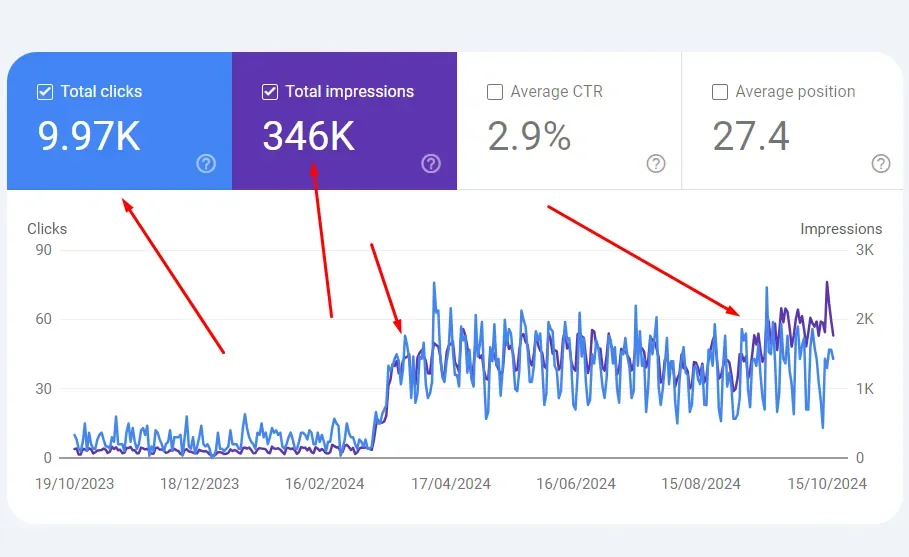
Search Console, 19 Oct 2023 – Oct 2024: 9.97K clicks from 346K impressions, CTR 2.9%, average position 27.4. Around the start of March 2024 the line jumps: daily clicks go from roughly 5–15 up to 30–70 and hold there into October 2024.
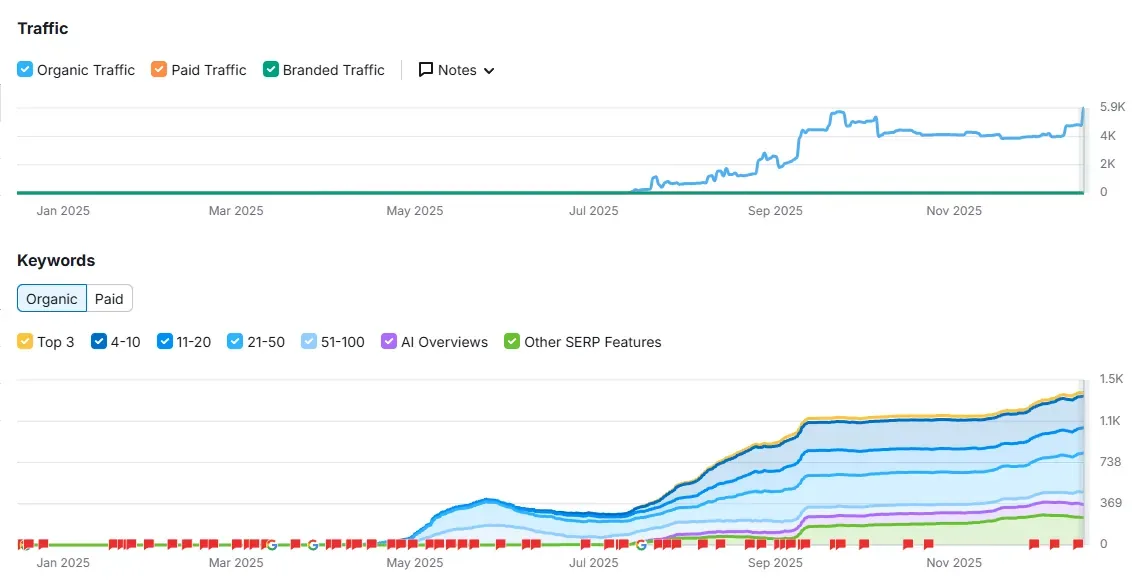
Semrush, 2025: estimated organic traffic sat at zero until July, then climbed to roughly 5.9K by year end; ranking keywords went from close to none to around 1.5K by December, with some in the Top 3 and some showing in AI Overviews.
What we would do next
With an average position of 27.4 in Search Console, many searches sit on pages two and three. We would focus on the pages with the most impressions and help them move up, through clearer structure, internal links and more authority. We would also keep monitoring indexing, because health sites add and update pages often, and new indexing problems can quietly come back.
What this project taught us
On health websites, rankings often stall on basics long before content gets its chance: unindexed pages, a broken sitemap and weak technical foundations. Clearing those issues early lets each page compete on equal footing.
On health projects we stay in our lane: we improve discovery and clarity, while clinicians own the medical substance.
Is this approach right for your site?
If your Search Console shows indexing errors or a failing sitemap, that is where we would start. Learn more about our SEO services and professional SEO services.
Evidence from the project
Screenshots from the client's own tools. Click to enlarge.