Project summary
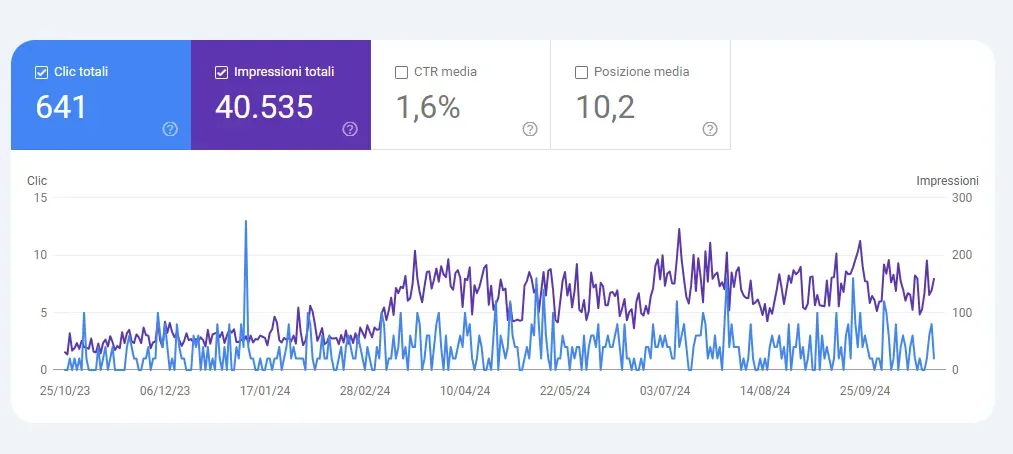
This hotel is in Italy. We were brought in to grow organic visibility so travellers discover the hotel on Google and reserve with it directly rather than only via booking sites. Search Console for the period credits the site with 641 clicks from 40,535 impressions at an average position of 10.2.
Data comes from the hotel’s own Search Console, in its Italian interface. The hotel stays private.
The problem: competing with booking giants
A hotel website does not only compete with the hotel down the road. It competes with booking sites and travel guides that have enormous authority. To be seen, its pages must match what travellers search for, work well on phones and be trusted by Google.
The situation in more detail
For an independent hotel, every booking through a third-party platform usually means paying a commission. Bookings made directly on the hotel’s own site avoid that. So the value of SEO here is not just traffic. It is the share of travellers who find the hotel’s own website instead of a listing on a booking platform.
The hotel’s Search Console runs in Italian, and all the numbers here are read from it exactly as reported.
Our strategy
We studied competitors first, since that reveals where one independent hotel can actually compete, such as precise local or descriptive queries, and where effort would be wasted. That shaped a plan of which pages should rank for which searches.
Why we chose this approach
A single hotel can’t outrank the big booking platforms on broad searches, and it doesn’t need to. Travellers also search in more specific ways, for example by place, type of stay or features, and those searches are winnable. Competitor analysis showed where the hotel could realistically compete, and the plan focused effort there.
Direct bookings were the business goal. Every visitor who finds the hotel’s own site, instead of a booking platform, is a chance to book directly, so visibility on the hotel’s own pages mattered more than anything else.
Step by step: what our team did
- Website audit for technical and on-page problems.
- Keyword research into how travellers search for a hotel like this, mapped to pages.
- Competitor analysis of hotels and travel sites already ranking.
- SEO strategy: which page targets which search, and what each needs.
- On-page SEO: titles and meta descriptions matched to traveller searches, a logical heading structure and internal links.
- Technical SEO so Google can crawl and index the site without problems.
- Backlinks and off-page SEO to grow authority.
What each step involved, and why it mattered
Audit and research
The audit found technical and on-page problems. Keyword research showed how travellers search for a hotel like this one, and competitor analysis showed which hotels and travel sites already ranked.
Strategy and on-page SEO
We decided which page targets which search. Titles and meta descriptions were matched to traveller searches, headings were put in a logical order and internal links connected the key pages, such as rooms and location information.
Technical SEO
Travellers often search on phones, so the site had to work well on mobile and be easy for Google to crawl and index.
Backlinks and off-page SEO
Authority from relevant sites helps a hotel compete in a space dominated by large platforms.
Results
- 641 clicks from Google Search and 40,535 impressions.
Average position 10.2, on the border of page one, CTR 1.6%.
Across the chart (25 Oct 2023 – about Oct 2024), impressions per day move from roughly 30–50 up to 150–250 from around March 2024 and hold at that level.
What we would do next
At 10.2 on average, lots of queries hover at the foot of page one or the start of page two. We would improve the pages behind those searches to move them a few places up, and work on titles and descriptions to lift the 1.6% click-through rate, since more clicks to the hotel’s own site means more chances for direct bookings.
What this project taught us
The March 2024 jump in impressions means Google began surfacing the hotel for far more queries, and kept doing so. For a hotel, steady visibility matters more than a spike. Since many queries sit around position 10, nudging those pages up a few spots is the clearest path to extra clicks and direct reservations.
Questions hotel owners often ask
Can a small hotel compete with booking sites on Google?
On broad searches, rarely. On specific searches about the hotel’s location, type of stay and features, yes, and that is where most of the opportunity is.
What does an average position of 10.2 mean?
It is the average ranking across all the searches the site appeared for. Many searches sit around the bottom of page one, so small gains in position can bring noticeably more clicks.
Run a hotel website?
See our SEO services and local SEO services.
Evidence from the project
Screenshots from the client's own tools. Click to enlarge.